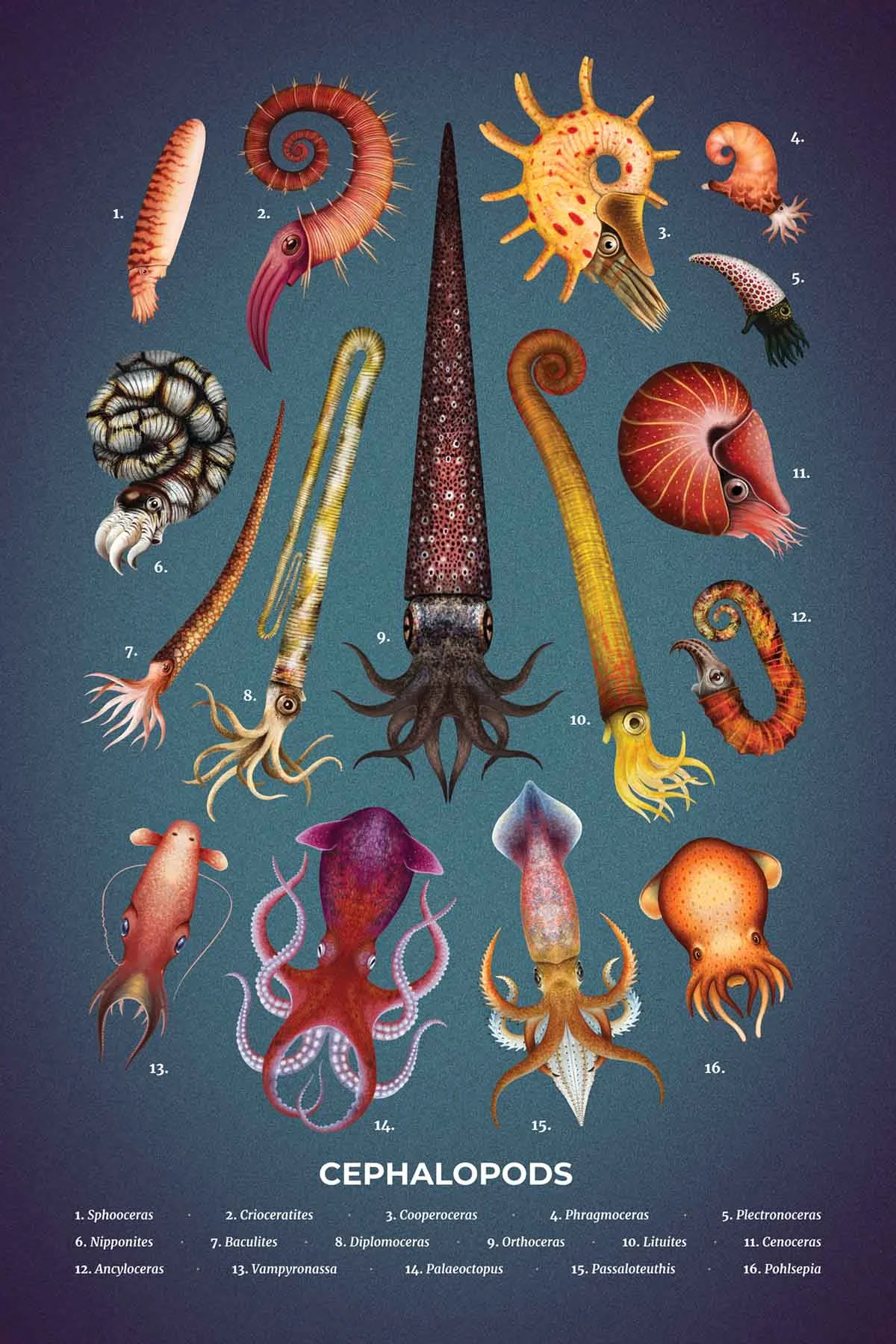

They may be no krakens, but many of them have spawned stories on their own. Squids’ long-lost relatives, the ammonites, are commonly found in many parts of the world.
Their spiral shells have been thought to be the remains of petrified snakes in England, a symbol of the God Vishnu in India, and charms to bring good luck in Buffalo-hunting by the Blackfoot and other indigenous peoples of North America.
It’s no surprise people thought of ammonites as anything but a “squid” in a shell. Together with their close relatives the snails and clams, cephalopods like squid, octopus, and ammonites are collectively known as mollusks. The name comes from the Latin word for “soft,” a nod to their squishy, moisture-filled bodies that don’t usually fossilize.
In the scientific community, it was a British polymath named Robert Hooke who first got pretty close to the truth. He lived in a time when fossils were thought to be oddities in nature that grew in rocks instead of the remains of living beings.
After European explorers brought back nautilus specimens from Indo-Pacific waters, he compared the spiral shells of ammonites with them in 1665. He suggested that the shells must have belonged to nautilus-like creatures that no longer exist on Earth. This idea was met with resistance from other naturalists of that time, who rejected the notion that many creatures on this planet must have gone extinct by means of large-scale disasters.